

The starting point I couldn’t find
I grew up with a parent who drank.
That sentence took me years to say out loud, and it still feels strange to see it written down.
For a long time it wasn’t something I talked about at all. It was just how home was: fine one minute, different the next, and me somewhere in the middle trying to work out which version of the evening we were getting.
I quietly assumed some of it must be my fault
I got very good at listening. From my room I could usually tell what kind of evening it was going to be from small things: the way the front door closed, how long the kitchen stayed quiet, the sound of a glass being set down.
Most nights were fine. But I did my homework with one ear on the house, just in case. I thought all of this was normal. And in the way you do when you’re young and nobody has told you otherwise, I quietly assumed some of it must be my fault.
The hardest part wasn’t any single bad night. It was the silence around all of it. I didn’t know anyone else living like this. Or rather, I didn’t know that I knew anyone, because nobody wears it on their uniform.
I kept it to myself
I’m a student at Eton, and one thing I’ve learned is that a parent’s drinking doesn’t care what school you go to or how things look from the outside. It happens everywhere, and it hides everywhere. So I kept it to myself, which is exactly what the silence wants you to do.
I can’t point to one moment when that changed. Somewhere along the way I started to understand that the drinking was not about me, that I couldn’t fix it, and that looking after myself wasn’t selfish.
Learning that took far longer than it should have, mostly because nobody had put it anywhere I could find it.
Here With Care
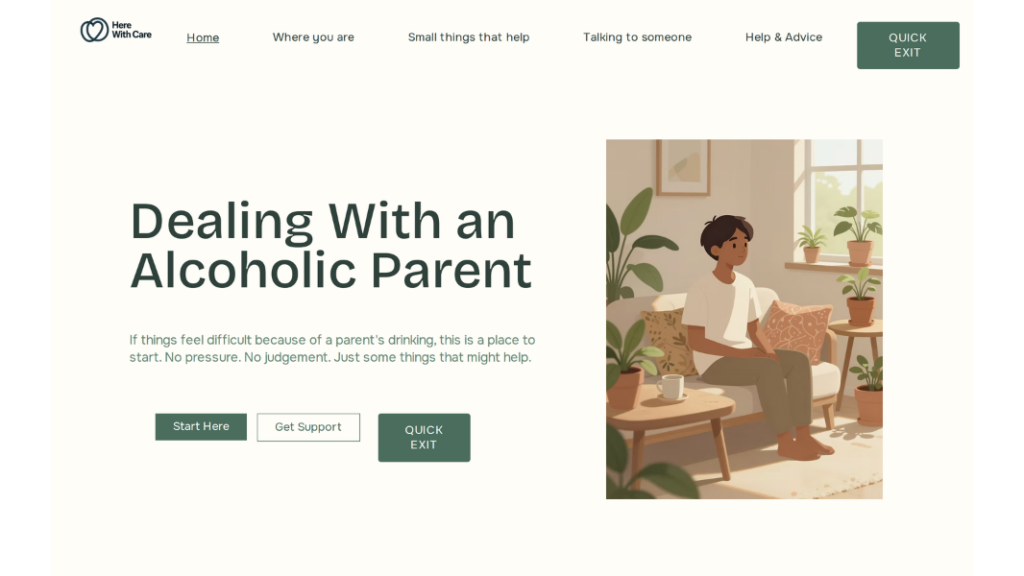
That is really why Here With Care exists. Over the past few months I’ve built a free website for teenagers who have a parent who drinks too much. I wanted it to be the page I couldn’t find: calm, non-judgemental, and written like a person rather than a leaflet.
It’s deliberately simple. It explains why a parent’s behaviour can change so suddenly, and makes clear that none of it is caused by anything you’ve done.
It offers small, realistic steps for looking after yourself on the hard days, rather than grand plans. And it shows you how to start a conversation with someone you trust, because you don’t need perfect words to ask for help. It’s okay if your voice shakes.
Just as importantly, it points to the people who can genuinely help, with Nacoa first on the list.
Here With Care isn’t a medical resource and doesn’t pretend to be one. It’s a starting point, built from my own experience and what I’ve learned along the way, for someone who might not feel ready to pick up the phone yet.
It isn’t your fault
Finding Nacoa mattered to me more than I expected. There is something quietly life-changing about discovering that a whole organisation exists for people like you, that there is a name for what you’ve lived through, and that the phone line has been there all along.
My hope is that the site helps even one person find that out sooner than I did.
If home sounds like the one I’ve described, here is what I most needed to hear. It isn’t your fault. You can’t control it and you can’t cure it, but you can take care of yourself.
You aren’t overreacting, and you are nowhere near as alone as you feel. Start small. Tell one safe person.
Or visit herewithcare.com, take your time, and when you’re ready, Nacoa’s free helpline is there on 0800 358 3456.
I built the website I needed. I hope you never need it. But if you do, it’s here, with care.
Here With Care is free to use at herewithcare.com, and you can find it on Instagram at @herewithcareofficial.
Photo by Lukas Rychvalsky on Unsplash.